An Alberta Residential Lease Agreement records the terms between a landlord and tenant when residential property is rented in Alberta. It helps both parties understand the rent, tenancy dates, security deposit, utilities, maintenance responsibilities, and other agreed conditions before the tenant moves in.
Use the free Alberta residential lease agreement template below as a starting point for documenting a residential rental arrangement. The agreement should reflect the parties’ actual understanding and comply with Alberta’s Residential Tenancies Act (RTA), where that legislation applies. A private template cannot remove rights or protections provided by the legislation.
Free Alberta Residential Lease Agreement Template (PDF)
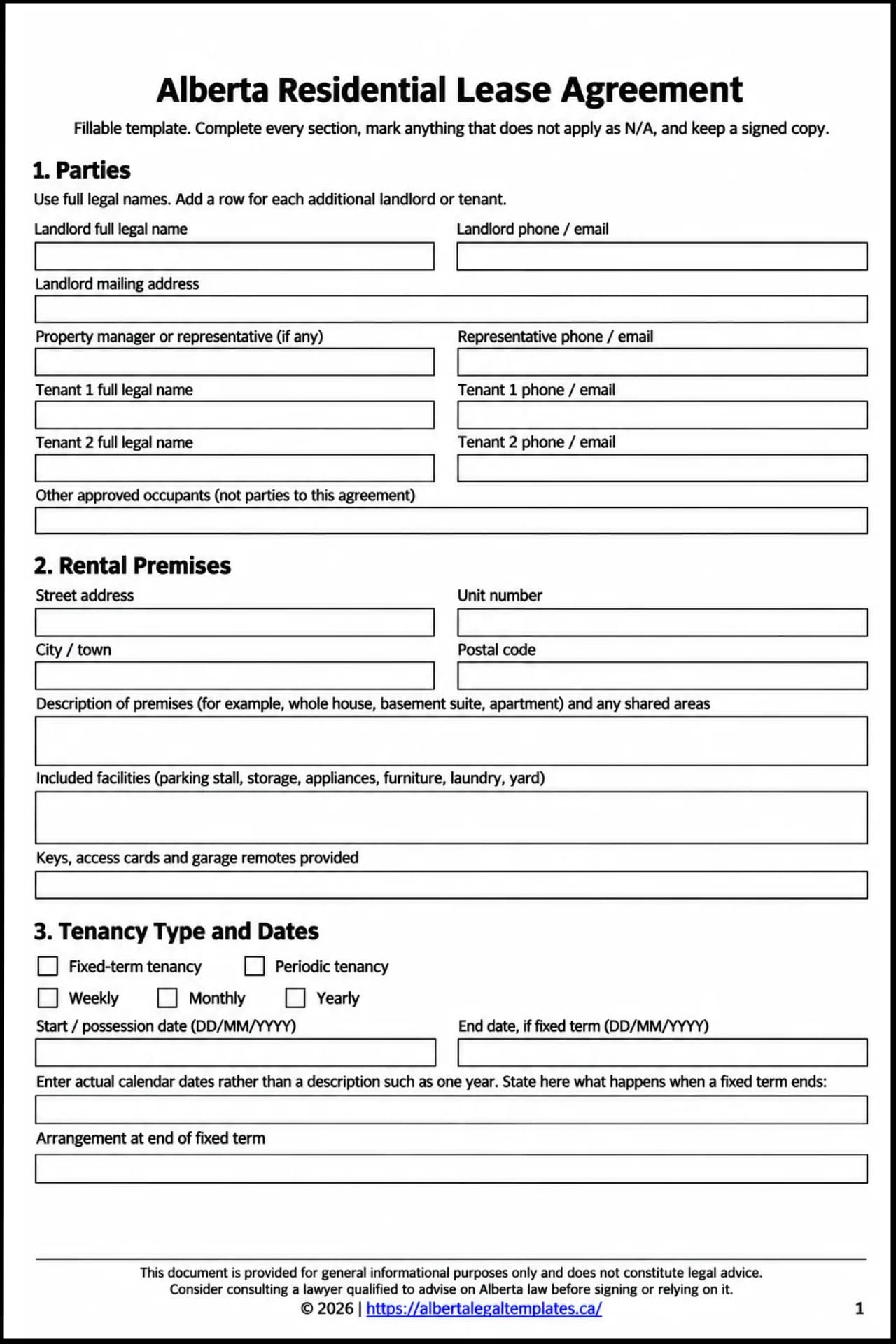
This free Alberta lease agreement template is available in PDF, printable, and fillable formats. It is intended to help landlords and tenants record the main terms of a residential rental arrangement in one written document.
A residential lease should clearly identify the parties, the rental premises, the tenancy period, the rent, and the responsibilities each party has agreed to accept. It should also explain arrangements for utilities, additional charges, security deposits, property maintenance, and other relevant conditions.
This is a privately prepared template, not a government-issued Alberta form. Before signing, both parties should review the wording carefully and check that it reflects the applicable Alberta tenancy rules. A standard template may need changes for an unusual property or rental arrangement.
What Does the Free Alberta Lease Agreement Template Include?
A useful Alberta residential lease agreement should provide space to record the following information:
- Landlord and tenant details: Full names and contact information for everyone entering the agreement.
- Rental property details: The address, unit number, and description of the premises being rented.
- Tenancy dates: The start date and, for a fixed-term tenancy, the agreed end date.
- Rent and payment arrangements: The amount of rent, payment frequency, due date, and accepted payment method.
- Security deposit: The amount collected, payment details, and agreed arrangements concerning its return and permitted deductions.
- Utilities and services: Which utilities, appliances, furniture, parking spaces, or other services are included and who pays for them.
- Maintenance responsibilities: The agreed arrangements for cleaning, repairs, yard care, and reporting maintenance problems.
- Property rules: Relevant conditions about pets, guests, smoking, parking, and shared areas.
- Signatures: Signature and date fields for the landlord and tenant.
Check the actual PDF before publication to ensure that its fields match this description. A separate property condition inspection report may also be necessary. The lease and inspection report serve different purposes and should not be treated as interchangeable documents.
Who Should Use This Alberta Residential Lease Agreement?
This template may be suitable for landlords and tenants arranging an ordinary residential rental covered by Alberta’s tenancy legislation. It can be considered for houses, apartments, condominiums, and other residential premises, provided the arrangement falls within the template’s intended scope.
Landlords can use a written agreement to record the rent, tenancy dates, property rules, and services they have agreed to provide. Tenants can review the document before signing to make sure that the property, payment terms, and responsibilities match what was discussed.
Property managers may also use a residential lease template when preparing an agreement on behalf of a property owner. They should confirm that they have authority to act for the landlord and that the final document accurately identifies the parties.
Do not automatically use this template for commercial premises, a mobile home site, or a living arrangement that may be exempt from the RTA. Those situations can involve different legal rules.
What Should an Alberta Residential Tenancy Agreement Include?
An Alberta residential tenancy agreement should explain the main terms of the rental in clear language. The Government of Alberta recommends recording information such as the parties’ names and addresses, rental property, tenancy term, rent, utilities, permitted occupants, deposit, maintenance responsibilities, insurance, additional fees, and signatures.
Written terms are particularly useful when the landlord and tenant later disagree about what was included in the rent, who was responsible for a repair, or whether a particular property rule was agreed. A written agreement gives both parties a record to refer to.
The agreement should not be used to remove tenant rights under the RTA. A term that attempts to waive rights protected by the legislation cannot override those statutory protections.
Landlord, Tenant and Occupant Information
Start by identifying every landlord and tenant who is entering the agreement. Use their full legal names rather than informal names or nicknames. Add accurate contact information so the parties can communicate about payments, repairs, notices, and other tenancy matters.
If a property manager or another representative will handle day-to-day matters, identify that person and explain their role. The agreement should still make clear who the landlord is. Do not assume that naming a property manager automatically replaces the need to identify the landlord.
It is also useful to list the people who are permitted to live at the rental property. Distinguish tenants who are parties to the agreement from other approved occupants. This can prevent later confusion about who has contractual responsibilities and who is simply permitted to reside at the property.
Rental Property and Possession Details
Describe the rental premises accurately. Include the complete street address, unit number, and any other details needed to identify the space being rented. If the agreement covers only part of a property, such as a self-contained basement suite, explain which areas are included and which are shared.
List any additional facilities included with the rental. These may include:
- A designated parking stall or garage space.
- A storage locker or shed.
- Appliances supplied by the landlord.
- Furniture included with the premises.
- Shared laundry, yard, or recreational areas.
Record the agreed possession date and any practical arrangements for receiving keys, access cards, or garage remotes. If the tenant is not receiving the entire property, describe the permitted use of common areas so both parties understand the arrangement.
Fixed-Term and Periodic Tenancy Details
Alberta recognizes fixed-term and periodic rental agreements. The parties should choose the arrangement they actually intend to create and make sure the dates and payment periods are consistent throughout the document.
A fixed-term tenancy has a specified start date and end date. Under Alberta government guidance, this type of tenancy normally ends on the agreed end date without either party having to give a separate termination notice.
A periodic tenancy has a start date but no fixed end date. It may run weekly, monthly, or yearly. The tenancy continues until it is ended in accordance with the applicable notice rules.
Some arrangements may begin as fixed-term tenancies and continue as periodic tenancies after the original end date. The agreement should not leave the parties uncertain about whether the tenancy is intended to end, renew, or continue under different terms.
For this reason, enter the correct commencement date and, where applicable, the end date. Avoid using vague descriptions such as “one year” without also recording the actual dates.
Rent, Payment Methods and Additional Charges
State the agreed rent amount and explain when and how the tenant must pay it. For example, an agreement might provide for a monthly payment on a specified day by electronic transfer or another method accepted by the landlord.
Identify the person or account receiving the payment. If the rent is paid by a method that requires reference details, explain what information the tenant should include. Both parties should retain receipts or other payment records.
Utilities and additional charges should be described separately from basic rent. Identify which services are included, which are paid directly by the tenant, and which are billed through the landlord or another provider.
Where the property uses a utility sub-meter, explain the billing arrangement and how the tenant’s share is calculated. Alberta government guidance says the sub-meter arrangement and the tenant’s responsibility for utility charges should be addressed in the tenancy terms. Do not leave the tenant guessing about how an additional utility amount will be calculated.
If the agreement includes charges for items such as parking, laundry, or other services, state the amount and when it becomes payable. Clearly distinguish refundable deposits from non-refundable fees. The legal treatment of a payment depends on its substance, not simply the label used in the agreement.
Security Deposit and Refundable Payments
Alberta limits a residential security deposit to no more than one month’s rent at the time the tenancy starts. A landlord cannot increase the security deposit later simply because the rent has increased.
Record the deposit amount and the date it is paid. The tenant should keep proof of payment, and the landlord should maintain appropriate records. Alberta requires security deposits to be placed in an interest-bearing trust account in an Alberta financial institution within two banking days after collection.
The agreement should explain the types of amounts that may be claimed from the deposit at the end of the tenancy, subject to the RTA. Examples may include unpaid rent or damage beyond normal wear and tear where the relevant legal requirements are met. A clause should not suggest that the landlord can automatically keep the entire deposit whenever the tenant moves out.
Interest is also relevant. The minimum annual security deposit interest rate changes according to the applicable regulatory formula. The Government of Alberta lists the rate as 0% for January 1 to December 31, 2026. Do not permanently hardcode that rate into a lease template. Check the rate applicable to the relevant year using the Government of Alberta’s annual security deposit interest rate information.
Maintenance, Repairs, Utilities and Insurance
Set out how ordinary property care and maintenance will be handled. The agreement can identify practical tasks such as keeping the premises reasonably clean, reporting leaks, disposing of garbage properly, and notifying the landlord when an appliance stops working.
Where the tenant is expected to look after a yard, walkway, or shared space, describe the task clearly. Avoid broad wording such as “the tenant is responsible for all maintenance” because it can create confusion about the difference between routine care and a repair that is the landlord’s responsibility under applicable law.
Explain how the tenant should report a maintenance problem. Include the appropriate contact method and any emergency contact details the landlord wishes to provide. This can help both parties respond promptly when a problem arises.
If the landlord requires tenant insurance, state the agreed requirement and explain what proof the tenant must provide. Insurance wording should be clear about the arrangement being requested. It should not be used to suggest that the tenant has assumed every risk or legal responsibility relating to the property.
Pets, Guests, Parking and House Rules
Record any agreed rules about pets, guests, smoking, noise, parking, waste disposal, and shared spaces. These provisions are easier to follow when they are specific. For example, identify the parking stall assigned to the tenant rather than simply saying that parking is included.
If pets are permitted, describe any agreed conditions, such as the number or type of pets and responsibility for cleaning up after them. If pets are not permitted under the proposed agreement, make sure the clause is consistent with applicable legal requirements and does not conflict with human rights protections or other legal obligations.
For condominium properties, identify relevant building rules and make sure the tenant receives the information needed to follow them. A landlord should not assume that a tenant knows the building’s parking, waste, amenity, or move-in procedures without being given the relevant details.
Choose the Right Type of Alberta Residential Tenancy Agreement
Not every rental arrangement should use the same document. Before signing an Alberta residential lease agreement, check the nature of the premises, who lives there, and whether the rental is covered by the RTA.
The correct document depends on the legal relationship being created. A lease for a self-contained residential unit is not necessarily suitable for a commercial property, a mobile home site, or a room in the landlord’s own living quarters.
Fixed-Term Residential Lease
A fixed-term residential lease is used when the landlord and tenant agree on a defined rental period. The document should state the exact start and end dates so the parties can identify when the agreed term is scheduled to finish.
This arrangement can suit a tenant who expects to rent for a known period or a landlord who wants the tenancy to run for a specified term. Both parties should review any early-termination wording carefully. Do not assume that a general clause allowing either party to leave whenever they wish accurately describes the legal position.
Under Alberta government guidance, a fixed-term tenancy normally ends automatically on the specified end date without a separate termination notice. If the parties want the tenancy to continue, they should discuss and record the next arrangement rather than relying on assumptions.
Periodic Residential Tenancy Agreement
A periodic agreement is appropriate when the tenancy has a start date but no fixed end date. Monthly tenancies are common, although Alberta also recognizes weekly and yearly periodic arrangements.
The agreement should state the rent period and the date payment is due. It should also make clear how the parties will handle notices and other communications. Termination notice requirements depend on the type of periodic tenancy and the party giving notice.
Do not copy a notice period from another province. Alberta has its own requirements, and the appropriate period should be checked against the current provincial rules before a clause or notice is prepared.
Renting a Condominium, House, Apartment or Basement Suite
An ordinary house, apartment, or self-contained basement suite may be rented using a residential tenancy agreement where the RTA applies. The document should describe the specific premises and explain which services and areas are included.
Condominium rentals may require additional attention. A landlord should check the applicable condominium bylaws and provide the tenant with relevant building rules. The lease should identify parking, storage, amenities, and shared facilities included with the rental.
Shared accommodation and landlord-occupied homes require a separate coverage check. A room rented in a home where the landlord also lives may be treated differently from a self-contained rental unit. Do not assume that the RTA applies to every room-rental arrangement.
When You Need a Different Rental Agreement
A residential lease template should not be used simply because money is being paid for the use of a property. The legal relationship may require another document or a different set of rules.
- Commercial lease: Used for premises rented primarily for business purposes.
- Mobile home site tenancy agreement: Used for renting a site for a mobile home, which is distinct from renting a residential unit under an ordinary residential lease.
- Sublease or assignment: Relevant when a tenant wants another person to take over or occupy the rental under an arrangement involving the existing tenant.
- Shared accommodation: May require a closer review of the living arrangement and statutory coverage before selecting a form.
If you are comparing several Alberta rental documents, see our broader Alberta rental and lease agreements resource. It covers the wider range of rental documents rather than focusing only on residential leases.
Renting a mobile home itself and renting the land on which it is situated should not automatically be treated as the same transaction. Check which agreement and legislation apply to the specific arrangement.
How to Complete and Sign the Alberta Residential Lease Agreement
Before signing, both parties should review the entire document and make sure it reflects their actual agreement. Completing the PDF carefully is more useful than signing a form with missing dates, unclear payment terms, or blank clauses that may later cause disagreement.
Gather the Information Before Filling Out the PDF
Collect the main information before starting the document. This reduces the risk of entering inconsistent details or leaving important terms undecided.
- Full legal names and contact details of the landlord and tenants.
- The complete rental property address and unit description.
- The agreed tenancy type, start date, and end date where applicable.
- The rent amount, payment frequency, due date, and payment method.
- The security deposit amount and payment record.
- Details of utilities, appliances, furniture, parking, and storage.
- Agreed maintenance duties, property rules, and additional charges.
If the parties have made promises about repairs, included furniture, or access to shared facilities, decide how those promises should appear in the agreement before signing.
Complete Each Relevant Clause
Enter information in the appropriate sections and avoid leaving important terms open to interpretation. If a clause does not apply, mark it as not applicable where the form permits. Do not leave a blank space that could later be mistaken for an unfinished term.
Any additional conditions should be written clearly and attached or incorporated into the agreement in a way both parties can identify. Each party should have the same final version. Avoid relying on a separate text message or verbal promise to explain a major term that is missing from the signed document.
Do not add a clause that attempts to remove a right protected by Alberta law. The parties can agree on many practical details, but their contract remains subject to the applicable statutory protections.
Review the Agreement Before Signing
Read the completed agreement from beginning to end. Check that the names, property address, dates, and rent amount are correct. Review the utility arrangements, security deposit, additional charges, and property rules carefully.
Pay particular attention to any clause that gives one party broad discretion. For example, a landlord should not assume that a lease can authorize entry at any time without regard to the applicable entry rules. A tenant should not assume that every payment described as a fee is automatically separate from a security deposit.
Check that any additional page or schedule is clearly connected to the agreement. If an attachment changes a term in the main document, the parties should resolve the conflict before signing.
Sign, Exchange and Retain Copies
Both parties should sign and date the final version. Make sure that every person intended to be a tenant or landlord is correctly identified and signs where required by the agreement.
Each party should retain a complete copy of the signed document, including all schedules and additional terms. Keep electronic copies in a location where they can be retrieved later. Payment records, written communications, and inspection reports should be retained with the lease documents.
Alberta’s tenancy legislation also contains rules concerning the provision of a signed copy and landlord identification information. The current statutory wording and timing should be checked before adding a deadline or notice clause to a template.
[NEEDS VERIFICATION: Confirm the current requirements and timing under the consolidated Residential Tenancies Act for providing a signed agreement copy and a notice identifying the landlord. The supplied legal-facts input did not contain the full current statutory text.]
Complete the Separate Move-In Inspection Report
A move-in inspection report is different from a lease. The lease records the rental terms. The inspection report records the physical condition of the premises at the beginning of the tenancy.
Alberta government guidance states that landlords and tenants must complete both move-in and move-out inspection reports. The report can help establish whether damage existed before the tenant took possession. It also matters when the landlord later considers deductions for damage or cleaning costs from the security deposit.
Walk through the premises and record its condition. Note existing marks, damaged fixtures, appliances that do not work, missing items, and any other relevant observations. Photographs can provide useful additional evidence, but they should not be treated as a substitute for completing the required inspection report.
Both parties should retain their copy of the completed report. For the current requirements, refer to the Government of Alberta’s tenancy guidance linked in the legal requirements section below.
Alberta Legal Requirements to Check Before Using a Residential Lease
An Alberta residential lease is a contract, but it does not operate outside the law. Where the Residential Tenancies Act applies, the agreement must be read alongside the minimum rights and responsibilities established by that legislation and its regulations.
The following checklist summarizes important matters to review before signing. It is not a substitute for checking the current consolidated legislation, especially where a tenancy has unusual features.
Does the Residential Tenancies Act Apply to Your Rental?
The RTA applies to most people who rent the place where they live in Alberta, but not every arrangement is covered in the same way. The type of property, the living arrangement, and the relationship between the parties can affect which rules apply.
For example, renting a mobile home site is not the same as renting residential premises under an ordinary residential lease. Certain room-rental arrangements where the landlord also lives in the home may also fall outside the usual RTA framework.
Before using this template, identify what is actually being rented. Is it a self-contained apartment, an entire house, a room in an owner-occupied home, or land on which a mobile home is placed? If the answer is not clear, verify the applicable legislation before choosing the form.
Required Wording and Landlord Information
A residential tenancy agreement cannot remove rights and protections given to tenants by the RTA. A clause that attempts to waive a protected right should not be relied on simply because both parties have signed the document.
The agreement should identify the landlord and provide accurate contact information. Alberta’s tenancy framework also addresses landlord identification information and the provision of a signed copy of a written agreement. The parties should not assume that an incomplete name or contact field is sufficient.
Some Alberta government guidance has described a prescribed statement for written agreements concerning the RTA taking priority over a conflicting lease term, including a larger-print requirement. Before inserting exact statutory wording into the template, compare the required text and formatting against the current consolidated legislation.
[NEEDS VERIFICATION: Confirm the current exact wording, placement, and print-size requirement for any mandatory statement in a written residential tenancy agreement before publication.]
Security Deposit and Inspection Rules
Alberta’s security deposit rules affect both the amount a landlord may collect and how the money must be handled. The deposit cannot exceed one month’s rent when the tenancy starts. The landlord must place it in an interest-bearing trust account in an Alberta financial institution within two banking days after collecting it.
The minimum interest rate is set through a regulatory formula and can change from year to year. For 2026, the Government of Alberta lists the minimum annual rate as 0%. The parties should check the rate for the relevant year rather than assuming that the same percentage will apply throughout the tenancy.
Inspection reports are another important protection. Alberta requires move-in and move-out reports. Government guidance states that a landlord cannot deduct amounts for damage or cleaning costs from the security deposit if the inspection report requirements have not been met.
These rules make it important to document the condition of the property at both ends of the tenancy. A vague lease clause about the deposit does not replace the required inspection process.
Rent Increases, Landlord Entry and Maintenance
Rent increase rules depend on the type of tenancy. Alberta government guidance states that rent cannot be increased during a fixed-term tenancy. For fixed-term and periodic agreements, a rent increase generally cannot take effect until at least 365 days have passed since the last increase or the start of the tenancy, whichever is later.
For periodic tenancies, the landlord must provide written notice that includes the date, the effective date of the increase, and the landlord’s signature. The minimum notice period depends on the rental period. Government guidance identifies 12 full tenancy weeks for week-to-week tenancies, 3 full tenancy months for month-to-month tenancies, and 90 days for other periodic tenancies.
Landlord entry is also regulated. A landlord may enter with the tenant’s consent. Where entry is sought without consent, Alberta guidance identifies specific circumstances in which written notice of at least 24 hours is required, including repairs, inspection of the property’s condition, pest control, and certain showings. Emergency entry and suspected abandonment are identified as exceptions.
The agreement should not give the landlord unrestricted access or suggest that the tenant is responsible for every repair. State the practical arrangements clearly, while recognizing that the applicable legislation continues to govern the parties’ legal responsibilities.
Are There Official Alberta Residential Lease Forms?
The Government of Alberta provides information about residential tenancy agreements and landlord-tenant responsibilities. The template offered on this page is a private document for recording agreed rental terms; it should not be described as a government-issued or government-approved form.
Alberta government guidance explains what information a residential tenancy agreement should contain. The government’s RTA handbook has also described that the legislation does not require one particular form of lease. Before making a definitive statement about the current prescribed-form position, check the current legislation and official forms catalogue.
An RTDRS application form is not a substitute for a residential lease. The Residential Tenancy Dispute Resolution Service is a tribunal process for eligible landlord-tenant disputes. It is separate from the agreement the parties use to record their rental terms.
What Happens After the Alberta Residential Lease Agreement Is Signed?
Signing the agreement is the beginning of the documented tenancy, not the end of the parties’ responsibilities. Both sides should keep the signed document, complete the relevant move-in records, and communicate clearly about any later changes.
Good records can help resolve practical disagreements about the condition of the property, rent payments, maintenance requests, or the terms the parties accepted.
Keep the Signed Lease and Supporting Records
Keep a complete copy of the signed lease and all attachments. The tenant should retain receipts or proof of the security deposit and rent payments. The landlord should maintain records of amounts received, repairs arranged, and communications relevant to the tenancy.
Keep the inspection reports with the lease. If the parties later agree to change a term, retain the written amendment with the original document. This makes it easier to identify which terms currently apply.
Taking Possession of the Rental Property
On the agreed possession date, confirm that the tenant can access the premises and any included facilities. Check that keys, access cards, parking arrangements, and appliances match what the agreement describes.
Complete the move-in inspection report and record any existing damage or maintenance concerns. If a repair has been promised before possession, keep a written record of the work expected and any agreed timing. The parties should not rely only on memory when documenting the condition of the property.
Changing or Renewing the Rental Agreement
A landlord and tenant may agree to change the terms of a residential tenancy during the tenancy, provided the new terms comply with the applicable legislation. Changes may involve rent arrangements, utilities, or the addition of another tenant.
Although changes may sometimes be agreed verbally, a written amendment is easier to prove if a disagreement occurs. Identify the original agreement, explain the term being changed, state the new wording, and have the parties confirm their agreement.
Do not assume that every change can be made unilaterally. A landlord or tenant should not treat a proposed change as effective merely because one party has sent a message announcing it.
Subletting or Assigning the Rental
A tenant who wants another person to take over or occupy the rental should check the rules for subletting and assignment before making an arrangement. Alberta government guidance states that written landlord consent is required. It also explains that a landlord cannot refuse permission without reasonable grounds and must provide written reasons within 14 days after receiving the request.
If the landlord does not respond within that period, the tenant may assume consent has been given under the government guidance. A landlord may not charge a fee for giving consent to a sublet. The original tenant may still have responsibilities under the existing agreement, so the parties should understand the arrangement before handing over possession.
Where to Get Help With an Alberta Tenancy Dispute
Landlords and tenants who cannot resolve a disagreement may be able to apply to Alberta’s Residential Tenancy Dispute Resolution Service (RTDRS). It is a quasi-judicial tribunal that deals with eligible disputes under the RTA and the Mobile Home Sites Tenancies Act.
Disputes may concern matters such as unpaid rent, security deposits, repairs, damage, or the termination of a tenancy. The RTDRS has eligibility requirements and an application process. Not every disagreement or claim will necessarily qualify.
Review the Government of Alberta’s Residential Tenancy Dispute Resolution Service information to understand the service and determine whether the issue may be eligible. An RTDRS application is separate from the lease agreement and does not replace the need to keep the signed rental documents and supporting records.
Frequently Asked Questions About Alberta Residential Lease Agreements
Is There an Official Alberta Residential Lease Agreement Form?
The Government of Alberta provides information about residential tenancy agreements, but the private PDF template on this page is not a government-issued form. Alberta’s RTA handbook has stated that the legislation does not require one specific lease form. Check the current legislation and official resources before relying on that position for an unusual tenancy arrangement.
Does an Alberta Residential Lease Agreement Have to Be in Writing?
Alberta government guidance recognizes written, verbal, and implied rental agreements. A written agreement is strongly recommended because it records the rent, tenancy dates, property details, and responsibilities the parties have accepted. It can also provide useful evidence if a disagreement arises.
What Should Be Included in an Alberta Residential Lease Agreement?
A residential lease should identify the landlord and tenant, rental premises, tenancy dates, rent amount, payment arrangements, utilities, security deposit, maintenance responsibilities, and relevant property rules. It should also include the signatures of the parties. The written terms must remain consistent with the RTA where it applies.
Can a Landlord and Tenant Change a Signed Lease?
Yes. Alberta government guidance states that the parties may amend a residential tenancy agreement when both the landlord and tenant agree to the new terms and the amended agreement complies with the legislation. Recording the change in writing is recommended because it provides a clear record of what was agreed.
Is a Move-In Inspection Report the Same as a Residential Lease?
No. A residential lease records the terms of the tenancy, while a move-in inspection report documents the physical condition of the rental premises at the start of the tenancy. Alberta requires move-in and move-out inspection reports. The inspection requirements can also affect whether a landlord may deduct damage or cleaning costs from a security deposit.
Legal information notice: This article provides general information about Alberta law and is not legal advice. The appropriate agreement and legal requirements may depend on the rental property and the parties’ circumstances. Consider consulting a lawyer qualified to advise on Alberta law before signing or relying on a legal document.